LGBTQ+ Vycinanki – series of artworks by Valerie Viecnazialony from Belarus that combines traditional Belarusian cultural motives with modern LGBTQ+ culture. Vycinanki is a traditional art form of papercutting, which became popular in the territories of Belarus, Ukraine and Poland. Each artwork represents an individual part of the LGBTQ+ community and combines them with elements of folk tales, religion, clothes, architecture and symbols of Belarusian people.
LGBTQ+ stands for: Lesbian, Gay, Bisexual, Transgender, Queer, Plus.
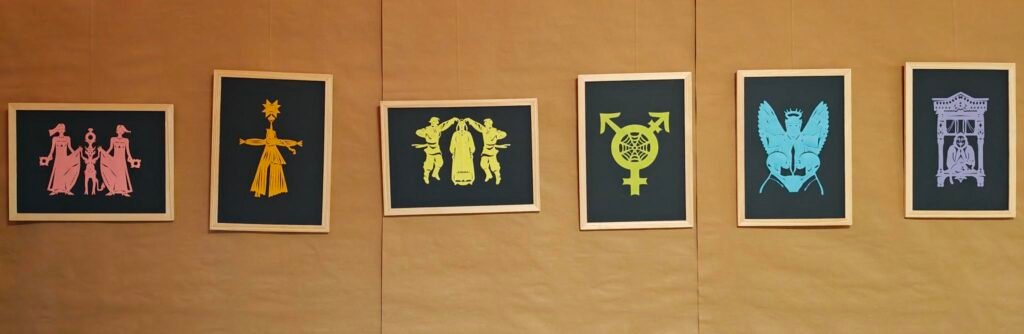
6 papercuts, each standing for one letter/sign of LGBTQ+
Picture Descriptions
Below you can find descriptions to the artworks. The descriptions have been added by the curators and are not done by the artist.
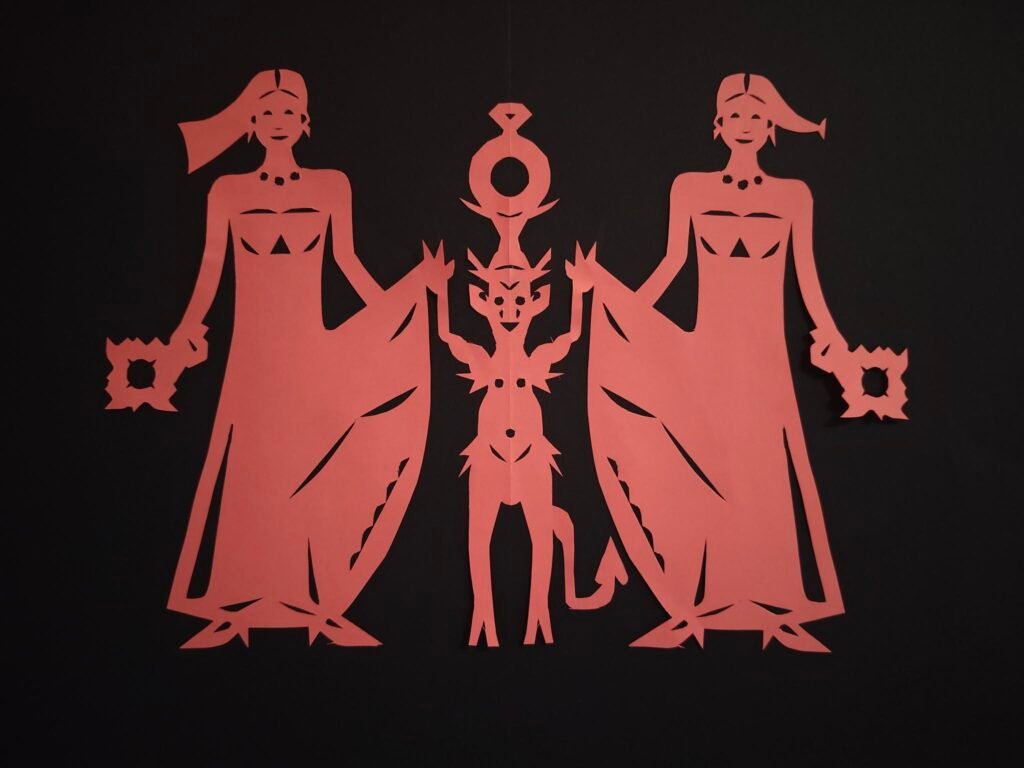
L – “L Vycinanka” (horizontal pink) – The paper cut-out of the letter L, standing for ‘lesbian’, is made of dark pink paper. To the left and right of the cut-out are two people, each wearing a dress, with long hair and holding a bouquet of flowers. Between them is a small figure that looks like a little devil. It has a devil’s tail, hooves and a ring on its head. The little devil is holding the two people’s hands aloft.
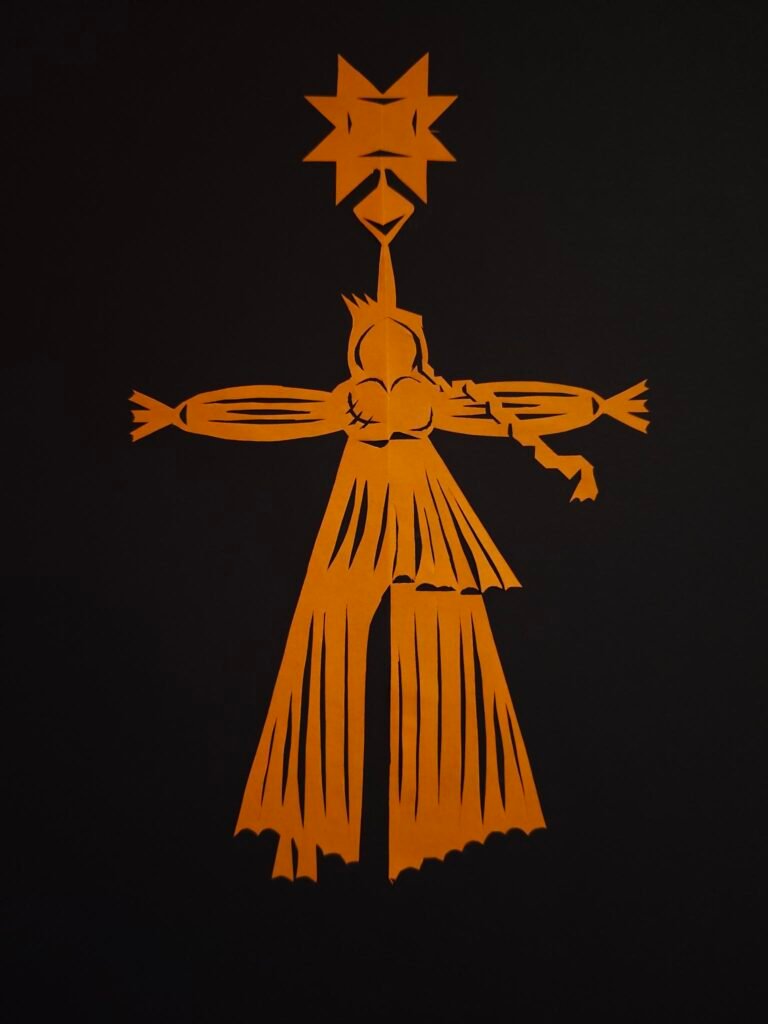
G – “G Vycinanka” (vertical blue) – The paper cut-out representing the letter G for ‘gay’ is orange in colour. It depicts a person with outstretched arms and one leg extended, as well as an octagonal star on their head. The figure is wearing a flowing, pleated garment consisting of a top and loose-fitting trousers. The top has an accentuated chest area; two slits on the left-hand side could also be interpreted as scars. The figure has a sort of short fringe swept up on the left side and a long plait on the right.
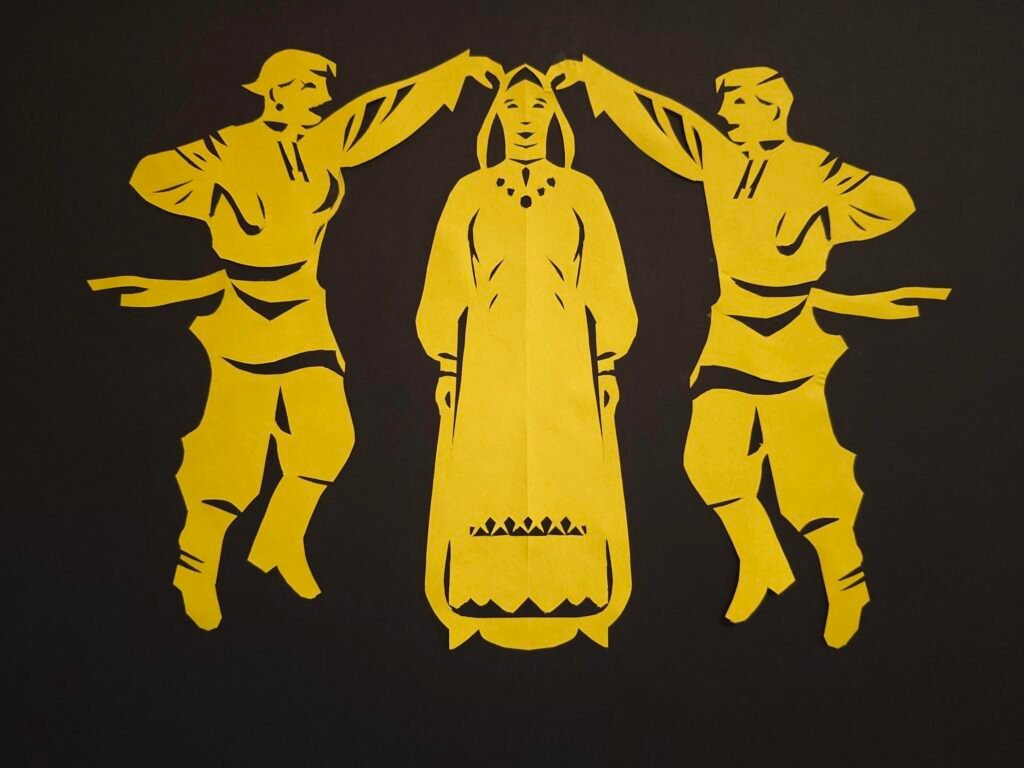
B – “B Vycinanka” (horizontal yellow) – The paper cut-out for the letter B, standing for bisexual, is yellow. It depicts three people. The people on the right and left of the image have their arms raised and appear to be dancing around the person in the middle. Both are wearing a top with a flowing scarf tied around the waist. They are wearing loose-fitting trousers and boots. The person on the left also has an earring and longer eyelashes. The person in the middle smiles and is wearing a loose-fitting dress with decorative embellishments, a necklace and a headscarf.
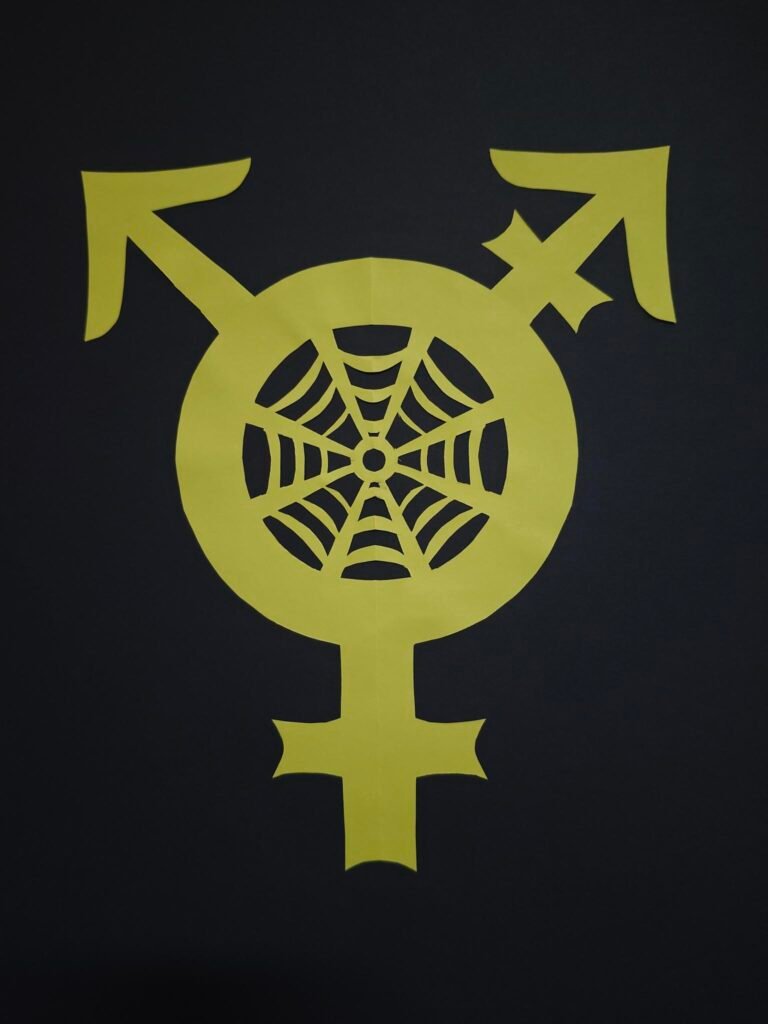
T – “T Vycinanka” (vertical orange) – The silhouette of the letter T for ‘Trans*’ is in light green. It depicts the trans symbol: a circle in the centre, with an arrow extending from it and pointing upwards to the left, representing male. A cross pointing downwards represents female. An arrow with a cross pointing upwards to the right represents both, as well as everything* beyond and outside. Inside the circle in the centre of the silhouette is a spider’s web.
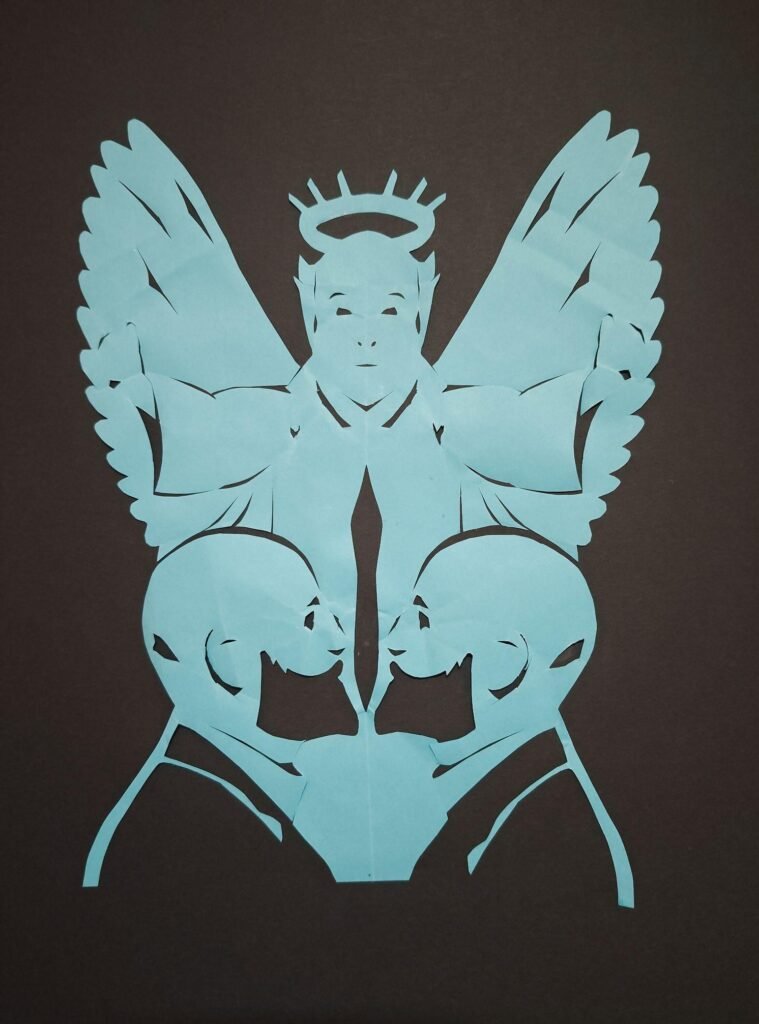
Q – “Q Vycinankila” (vertical purple) – The silhouette representing the letter Q for ‘Queer’ is in light blue. The lower half of the image shows two people in profile, both with beards and wearing suits. The two are standing very close together and looking into each other’s eyes. Above them, a figure with wings has its arms outstretched, as if bestowing a blessing. This figure is wearing a robe reminiscent of that worn by Christian clergy and has a halo.
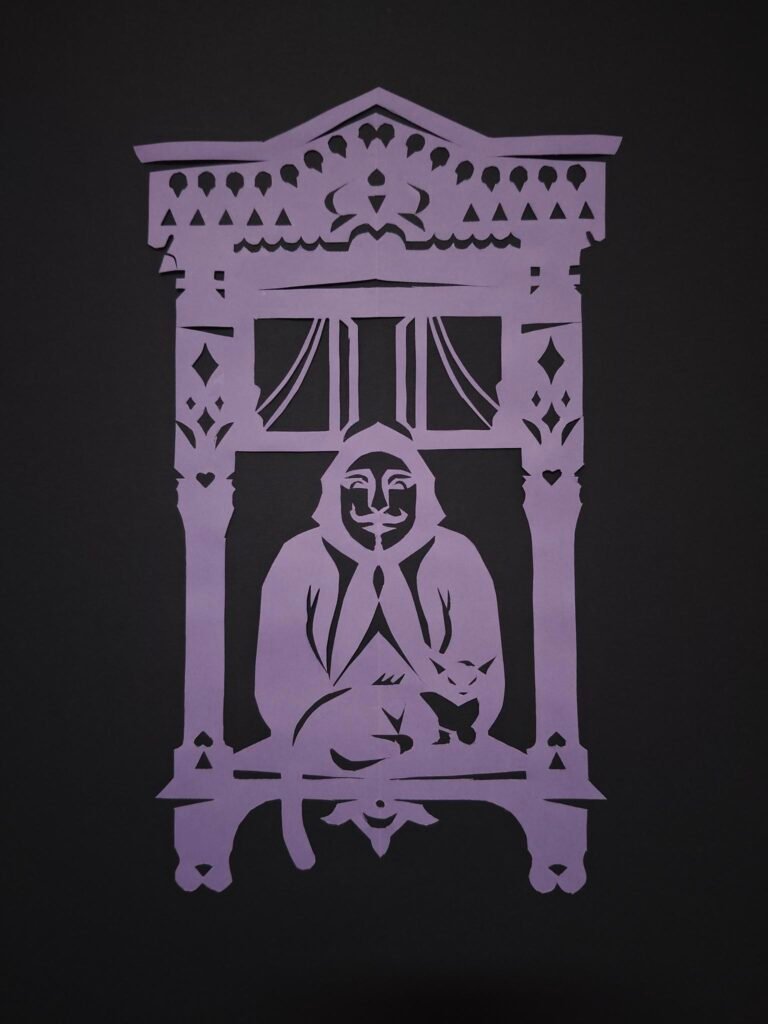
+ – “+ Vycinanka” (vertical green) – The silhouette of the ‘+’ symbolises ‘plus’ and is purple in colour. ‘Plus’ represents all people and identities who do not identify with the letters LSBGTQ as they currently stand, yet are still part of the queer community, and highlights the fluidity and changeability of terms and identities. The image shows a person with a cat on their lap, looking out of a window. The window is adorned with many decorative motifs. The person has emphasised eyes, a moustache and is wearing a loose-fitting top. It looks as though the person is wearing a headscarf or has a bob hairstyle. The cat has pointed ears and narrow eyes.
Common Threads – Exhibition
From October 9 to 11, the exhibition “Common Threads” (Geteilte Fäden) was presented in Fürstenberg (Havel), Brandenburg, in October 2026. The exhibition is a collection of works by artists and collectives from Ukraine, Moldova, Belarus, and Germany. Some of these works were created during our educational trip to Moldova in April 2026 as part of the “Decolonizing Cultures of Remembrance” project.